
The last few days have been quite a rollercoaster ride for market participants, and the “correction” in equities and rates has left a lot of people counting losses. Not a pretty sight. Reasons put forward for the moves have been several: stretched positioning, herd behaviour by asset managers, the usual “it’s the algos stopping out”, and, on a broader level, regulation and the impact it’s having on liquidity in most asset markets.
So what’s going on?
Although all of the above explanations for the rally in US Treasuries and the drop in equities seem reasonable (CFTC shorts by non-commercial players in 2yr US Treasury Futures below, talking about being all on the same side of the boat. See the below chart, speaks louder than a thousand words), regulation is really the driver behind recent jump in volatility.
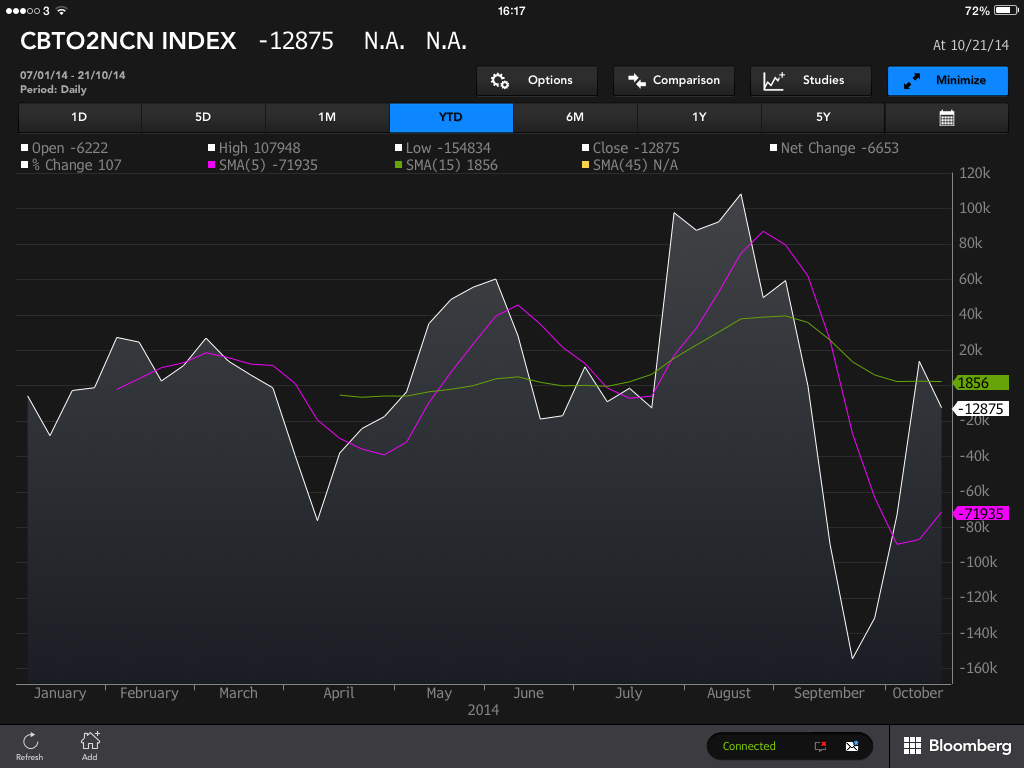
CFTC 2yr Treasury Futures positioning – Non-commercial Source: Bloomberg
The story is one we are now familiar with. As Basel III kicks in properly in January next year, with the first phasing in of liquidity coverage ratios, net stable funding ratios and leverage ratios, banks will have to adhere to stricter liquidity and leverage limits, impairing their ability to hold assets and warehouse risks.
Banks have already been reducing their exposure to less liquid assets, reducing inventory between 30% and 80% depending on the product. With the shock – absorbing capacity no longer there, markets can get really messy really fast, as we have seen in the last couple of weeks.
What does this mean for asset prices and yields?
What seems evident is a stronger preference for liquid assets, more than usual, in time of stress, a higher liquidity premium attributed to high – quality liquid collateral as defined by Basel III (this includes all assets that are eligible to be posted as repo to central banks).
In a world where the central banks dampen volatility and flood the market with liquidity, prices may not necessarily reflect the difference between assets, but when flight – to – quality (FTQ) kicks in, the good stuff to keep on balance sheet that’s not too heavy from an RWA perspective is hard to come by.
I think the market has now painfully realized that, and is repricing the liquidity premium into yields, re – marking spread levels and making a clearer distinction between good and bad collateral.
Looking at cross – currency swaps and swaps spreads, the flight to quality flows have been substantial this last quarter-end, with a large preference for “safe” USD assets likely driving part of the moves in Treasuries, credit and equities. I don’t think it’s a coincidence that the moves that have rattled the market have started around that time, bearing in mind the overstretched positioning, particularly at the front end of the US yield curve.
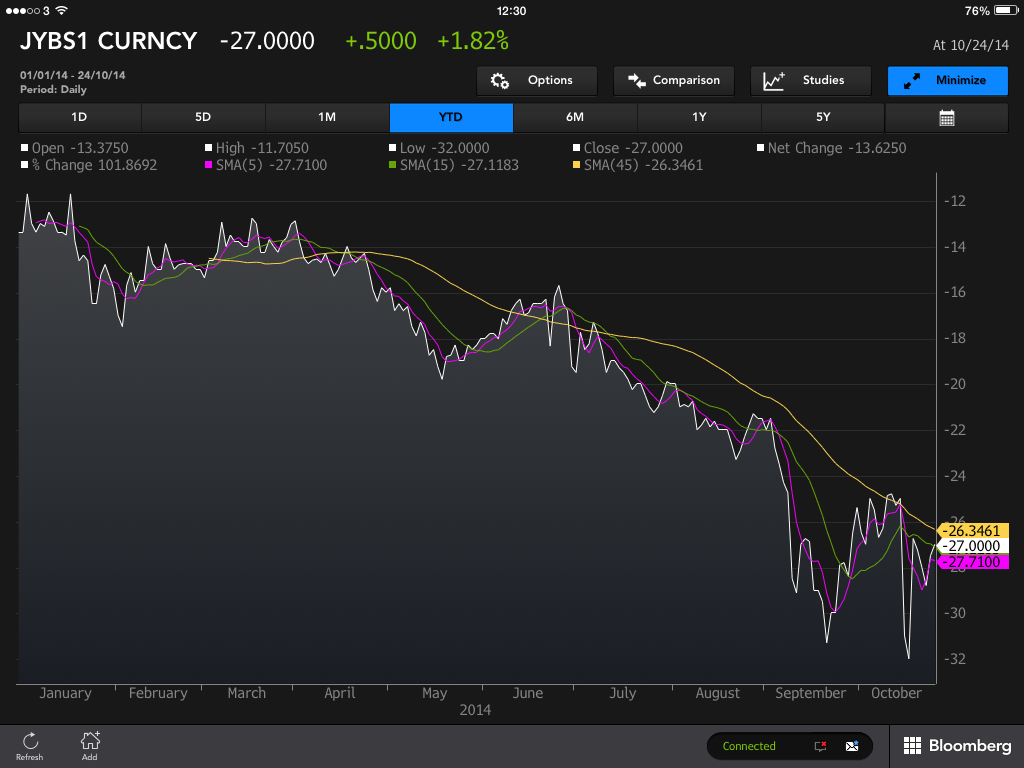
USD JPY 1yr x-ccy basis swap – Source: Bloomberg

EUR USD 1y x-ccy basis swap – Source: Bloomberg
Going forward I think we are going to see more of this, and more than we have been used to in the last few years of Fed – driven asset markets, and with regulation now having a bigger impact on pricing and investment decisions.
Yes, on the one hand with the US further ahead in the business cycle compared to the rest of the world, and the Fed now no longer purchasing assets, there is only so much that US yields can fall by, but at the same time regulation – induced demand is likely to prevent bonds from selling off in any meaningful fashion any time soon. In a way this could be loosely compared to the Too Big To Fail funding benefit that large US banks had compared to smaller players in the middle of the financial crisis (GS wrote a nice piece about it a few months ago, available here)
Where’s the trade?
Although a lot of the FTQ premium has been priced into asset markets, I think that going forward there is still scope for some of the tensions to reappear, particularly around month – end / quarter end.
Over the next few days markets are likely to continue taking a breather following reassurances by central banks that stimulus reduction won’t be abrupt, also in light of the fact that the ECB’s AQR result are, in my mind, not a huge surprise in a negative sense. If anything at the margin they are quite positive, once considered the recap that banks have already carried out since March 2014.
This should present some good opportunities to put on cheap insurance trades, taking the recent moves as an example and considering the broader macro views discussed in previous posts.
Here’s some examples.
- Long Bunds ASW spreads
Europe is sinking, deflation is very much a reality, and the ECB will need to do something soon. Long Bunds ASW spreads gives a good exposure to ECB QE, while providing some cushioning in the event of another round of more general risk aversion.
- Borrow (BUY / SELL) USD in the FX forward market, particularly vs. EUR and JPY.
I would suggest 6months/6months forwards or even 1y1y forward, unfortunately I don’t have all the forward curves in front of me, but you get the idea).
The carry is negative but not too expensive, and it’s a good insurance policy to have vs. a portfolio long risk.
- Buy USD risk reversals. As the probability of flight to quality episodes increases and demand for USD pushes the USD forward curve higher, risk reversals should rise accordingly.
Correlations and carry should be taken into consideration, and might not fit all portfolios in the same way, but I think they are worth considering.
Thoughts and feedback always welcome!
AI
 MacroCentral.com
Nice article
LikeLike
questionable the link between a well known and long anticipated regulatory “change” and very recent market dynamics.
FTQ is just the unavoidable consequence of a number of trailing macro events and the preference for USD assets simply reflects the fact that most of those events are Euro/Europe driven (and btw if that can be true for some AM, it is less so for non-US banks who would be penalized by investing in USD)
LikeLike
Thank you for the comment. I would argue that although the reg reforms have been largely known for a while now, the liquidity impact is now exacerbating moves that would have otherwise been smaller.
I don’t think the fx denomination of the sovereign debt is that much of a catalyst but rather how much it weigh on banks balance sheets.
I don’t have the data available, but if you have it, I think it would be interesting to see if there is any empirical evidence of liquidity premium being priced into yield curves (once you’ve carved out term premium and credit components) and how this has evolved over the last couple of years, and how it will evolve as the Fed pulls the foot from the accelerator.
LikeLike